Now Reading: The Heart That Holds Two Worlds
-
01
The Heart That Holds Two Worlds

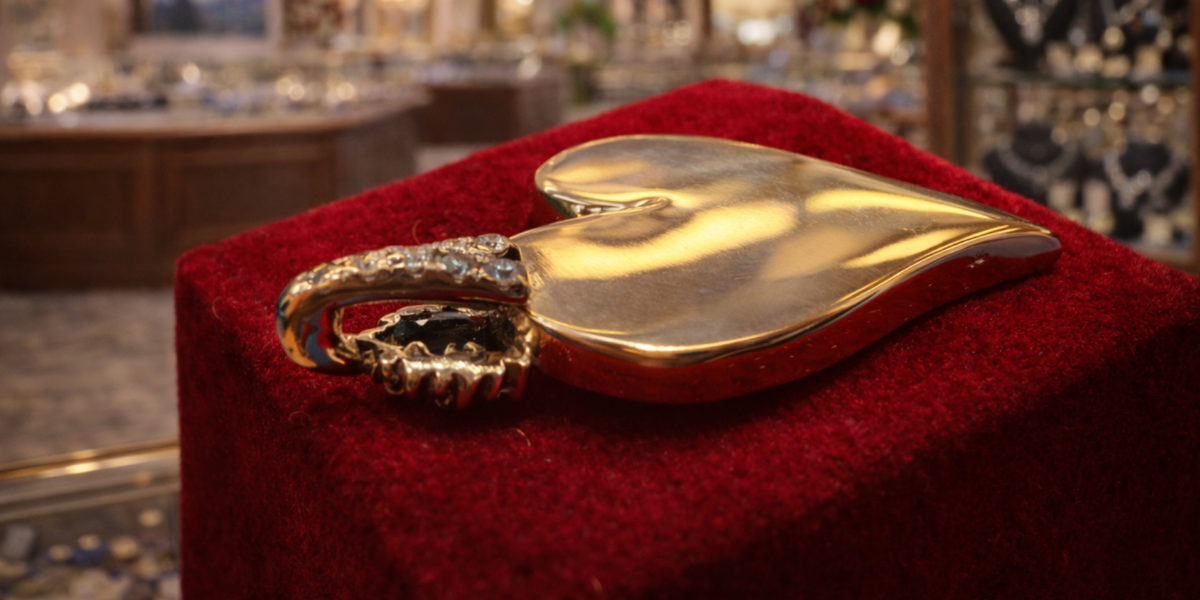
A Smithsonian recognized, one of one heirloom pendant crafted in a full ounce of gold at Blue Wolf Fine Jewelry in Lawton, Oklahoma
LAWTON, OKLAHOMA — Some pieces are made to be admired. Rarely, a piece is made to be remembered, to carry its own gravity, to feel inevitable in the hand, and to leave the quiet certainty that it will outlive the moment that first discovers it. The Two Worlds Heart Pendant is that kind of creation.
Designed and handcrafted by Lisa Christiansen McFall, a citizen of the United Keetoowah Band of Cherokee Indians and the sole owner of Blue Wolf Fine Jewelry, this one of one pendant lives at the intersection of art, legacy, and precious material truth. It is not inspired. It is authored. It is not an accessory chasing a season. It is an heirloom insisting on permanence. It arrives with a rare distinction that shifts the conversation from style to significance: the Smithsonian mentioned recognizing this Two Worlds Heart Pendant.
Museum recognition changes the language around an object. It invites a deeper reading that considers craft not only as ornament, but as cultural artifact, not only as beauty, but as lasting meaning.
Yet before anyone speaks of recognition, the pendant speaks for itself. The first impression is physical: the weight, the presence, the unmistakable heft of something made without compromise. This is not lightweight gold made to look substantial. This is substance, measurable and immediate, one full ounce of gold expressed as one half ounce of pure solid 14 karat yellow gold on the front and one half ounce of pure solid 14 karat white gold on the reverse. The numbers are not a footnote. They are the foundation.
True luxury is not repetition. It is permanence made visible, made wearable, made to last.
A Heart, Reimagined as Architecture

Hearts fill jewelry cases across the world, charmed, petite, familiar. But the Two Worlds Heart refuses to be familiar. It is not the heart as cliché. It is the heart as form, sculptural, composed, and undeniably grown up. It feels less like a symbol and more like a statement.
On the front, the pendant is pure solid 14 karat yellow gold, mirror polished into a surface that behaves like captured light. Under boutique chandeliers, the gold does not merely shine. It glows, returning warmth to the room. It reads like sunlight held still, smooth, bright, and elegantly restrained.
The silhouette is clean and confident, with curves that feel designed rather than decorated, an assurance that comes only from refinement. There is no unnecessary embellishment across the heart’s face, and that restraint is precisely what makes it powerful. In the highest tier of luxury, restraint is not minimalism. It is control. It says the material is enough. The form is enough. The artistry is in the decisions you do not rush.
At the top, where pendant meets chain, Christiansen McFall introduces a jeweled flourish that completes the composition: a sculptural bail that rises like a crown. It is more than a connector. It is punctuation, an intentional moment of dimension, sparkle, and signature presence. This detail is the difference between jewelry that is pretty and jewelry that is unmistakably authored.
When displayed on crushed red velvet, the pendant becomes almost cinematic. Yellow gold against deep crimson, polish against texture, brilliance against shadow. The velvet does not compete. It frames. It makes the gold look even warmer, even more luminous, as if the pendant were lit from within.
Turn It Over: The Second World Reveals Itself
Then comes the moment that makes the pendant unforgettable. You turn it over and the story changes.
The reverse is pure solid 14 karat white gold, a full half ounce, not plated illusion, not thin overlay, but an entire second identity in precious metal. Where yellow gold glows, white gold gleams, cooler, brighter, quietly commanding. It has a different voice, moonlight instead of sunlight, clarity instead of warmth.


Within that white gold face is the signature element that gives the piece its name and its meaning: an open heart cutout. This is not a decorative afterthought. It is the pendant’s thesis. Through the aperture, the wearer catches a glimpse of yellow gold beneath, warmth revealed through coolness, one world visible inside the other.
It transforms the pendant from front and back into a dialogue. Two metals conversing. Two worlds coexisting. The visible and the intimate sharing the same heart without contradiction.
In that single cutout detail, the pendant becomes more than precious. It becomes personal. It invites touch. It invites turning the piece in the fingers again and again, the way people handle objects that matter.
One Ounce of Gold: The Heirloom Signal
The fastest way to identify true heirloom jewelry is not the label or the marketing language. It is weight.
The Two Worlds Heart does not disappear when worn. It sits with authority. Its mass changes everything, how it drapes, how it moves with the body, how it catches light when you breathe or turn. The wearer does not simply put it on. The wearer carries it.
In a market flooded with hollow forms and lightweight shortcuts, this pendant’s full ounce of gold reads like a declaration of standards. It signals permanence. It signals longevity. It signals a refusal to compromise.
Heirloom jewelry has always been about more than value. It is about continuity, objects that hold memory, witness milestones, and eventually pass from one set of hands to another. The Two Worlds Heart feels designed for that exact life, not merely to be owned, but to be inherited.
Smithsonian Recognition and the Quiet Power of Cultural Attention
The phrase museum recognized is often used casually, an echo of prestige without substance. But when the Smithsonian mentioned recognizing the Two Worlds Heart Pendant, it suggested a different kind of attention, one that sees beyond trend and into craft, beyond fashion and into significance.
Museum recognition changes the frame. It asks different questions about technique, authorship, and meaning. It positions the pendant as more than adornment, as wearable art worthy of conversation. It is not simply a beautiful heart. It is a designed object that carries a story in its construction, two metals, one form, one revealed through the other.
That is the kind of concept museums understand instinctively: symbolism made physical through craftsmanship, a narrative held in precious material, an idea rendered in metal so it can last.
The Maker and the House: Authorship Intact

Luxury at its finest is not only about materials. It is about provenance. In today’s world, provenance has become complicated, with designers separated from makers, brands separated from origin, and craftsmanship outsourced into anonymity.
Blue Wolf Fine Jewelry is the opposite of that.
Lisa Christiansen McFall is not a distant name attached to a product. She is the designer and the maker, present, tangible, and rooted. She is also the sole owner of Blue Wolf Fine Jewelry, which means the authorship remains intact from concept to craft to presentation. The piece is not diluted by committee. It is not shaped by trend forecasting. It is the direct expression of a singular vision.
Her identity as a citizen of the United Keetoowah Band of Cherokee Indians adds a deeper dimension, a living heritage that does not need to be advertised loudly to be real. It simply is. The work carries the composure of authenticity, quiet, steady, and undeniable.
This is how true luxury feels: not borrowed, not performative, not manufactured for the moment, but authored and owned.
Why Lawton, Oklahoma Belongs on the Luxury Map
The luxury world loves predictable addresses. But modern collectors are shifting. They want authenticity. They want story. They want discovery. They want to know where a piece was born and to feel that place inside the object.
That is how Lawton, Oklahoma becomes part of this narrative, not as an unlikely footnote, but as a compelling setting. In the historic district, Blue Wolf Fine Jewelry functions like a destination atelier, a place where you do not just shop, you encounter.
The Two Worlds Heart is best experienced in person. In photographs, it is striking. In reality, it becomes something else entirely: weight, light, and texture working together. Yellow gold catching chandelier glow. White gold sharpening it into brilliance. The cutout revealing warmth beneath. Velvet framing everything like a stage.
It is the kind of piece people do not simply like. They talk about it. They share it. They tell someone you have to see this.
Where to View the Two Worlds Heart
This one of one heirloom pendant can be viewed at:
Blue Wolf Fine Jewelry
Flagship Boutique Historic District
1103 SW C. Ave
Lawton, Oklahoma
Go slowly. Ask to see both sides. Let the yellow gold face glow. Turn it over to the white gold reverse. Find the cutout and watch the story reveal itself. Feel the full ounce of gold and understand, in a single moment, why some jewelry is not made for a season but for a legacy.
Because in the end, the Two Worlds Heart is not merely a pendant.
It is a work of permanence, crafted to be worn now and treasured forever.