
Behind carved stone facades and discreet brass plaques, capital rests in silence, bullion stacked in geometric certainty, bearer bonds archived in climate controlled precision. Wealth here is not loud. It is deliberate. It values instruments that outlast volatility.
Across the Atlantic, in Manhattan’s penthouse offices and Upper East Side salons, permanence carries a different rhythm. Art commands walls. Provenance commands conversation. Scarcity commands premium.
It is between these two financial temperaments, Swiss restraint and New York momentum, that Lisa Christiansen’s work finds uncommon resonance.
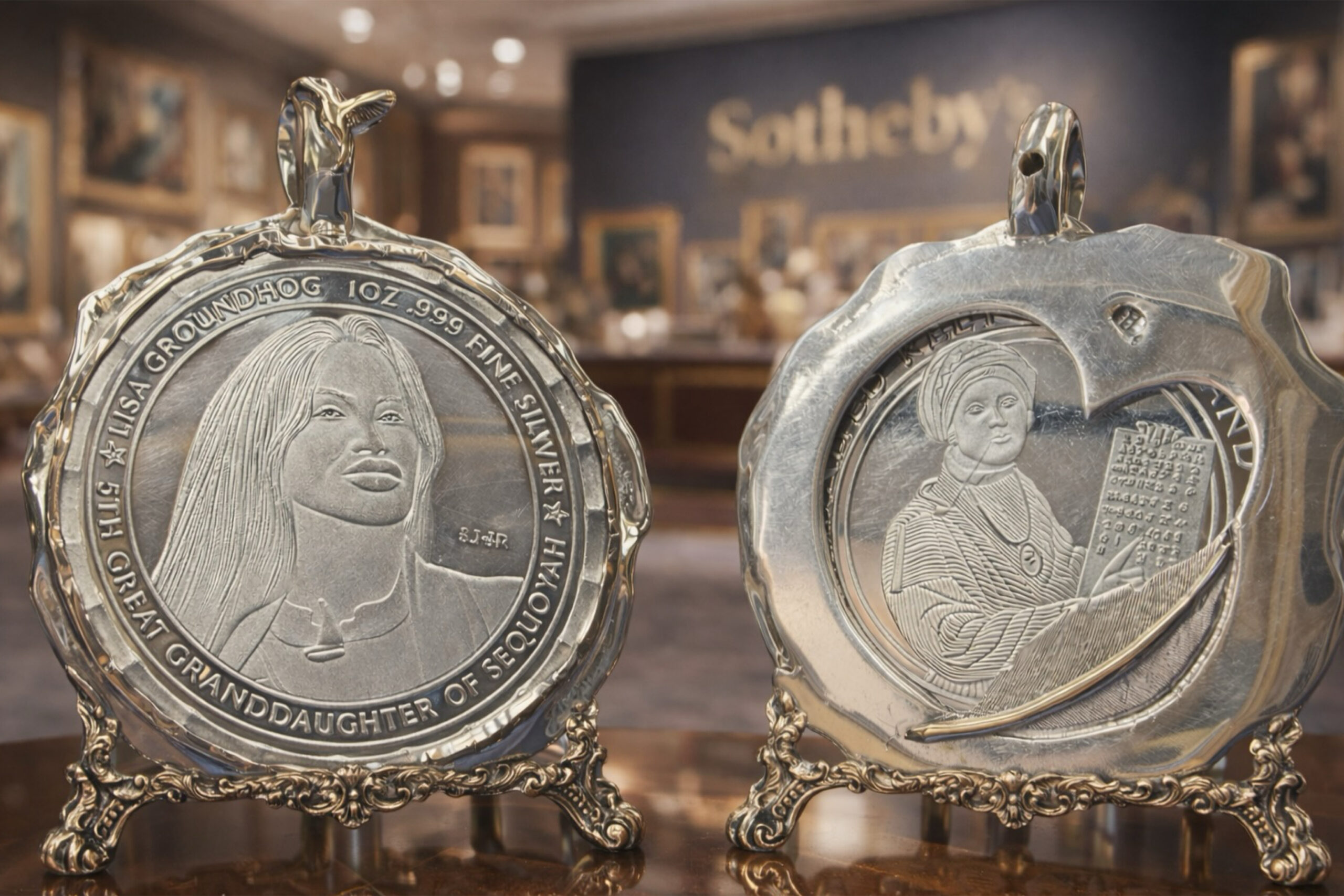
She sits in her Lawton, Oklahoma atelier surrounded by the quiet sheen of silver and gold. The light falls softly across her workbench. Tools rest within reach. A single commemorative silver dollar lies centered before her, one of sixty one known strikes honoring Sequoyah, the Cherokee statesman who created the syllabary that gave his nation written language.
The coin is already rare.
What transforms it is what she has done next.
Christiansen, founder of Blue Wolf Fine Jewelry and documented fifth great granddaughter of Sequoyah, has fabricated a one of one sterling silver mounting, integrating gold and gemstone elements that convert commemorative metal into authored heirloom.
The result is not accessory.
It is position.
A Bloodline in Silver
Sequoyah’s legacy is often described in intellectual terms. He created, independently, the Cherokee syllabary, one of the only writing systems in history developed by a single individual and adopted with extraordinary speed. Within years, the Cherokee Nation achieved literacy rates that rivaled or exceeded surrounding American communities.
Less frequently emphasized, yet equally revealing, is that Sequoyah was also a silversmith.
Before and during his linguistic achievements, he worked with metal. He engraved, shaped, and polished silver. His hands understood permanence before his mind translated sound into symbol.
Two centuries later, his fifth great granddaughter Lisa Christiansen (Groundhog) shapes silver again.
The continuity is not poetic coincidence. It is material inheritance.
“Silver began the lineage,” Christiansen reflects quietly. “Silver sustains it.”
On her workbench rests the commemorative coin, struck in a strictly limited issue of sixty one known examples. In numismatic terms, supply is already controlled. Yet she has intervened with deliberate authorship.
She fabricates a sterling silver bezel entirely by hand.
Into the heart form, she carves a feather quill, not applied ornament, but integrated sculpture. The quill’s spine is solid 14 karat gold. At its tip, a single diamond is set as the nib.
Gold for structure.
Diamond for indelibility.
The act of writing, rendered in precious architecture.
Above, a 14 karat gold hummingbird crowns the bale. Within Indigenous symbolism, the hummingbird carries resilience and continuity of spirit. Here, it appears to suspend not merely metal, but lineage.
A discreet sapphire hallmark completes the composition, her authentication signature embedded within the piece.
Sixty one coins were struck.
Only one was transformed in this way.
Geneva The Mathematics of Scarcity
In Switzerland’s wealth culture, valuation begins with tangible metrics.
Fixed supply 61 strikes.
Unique configuration 1 of 1 mounting.
Material integrity .999 fine silver, sterling silver, 14 karat gold, diamond, sapphire.
No secondary market dilution.
The intrinsic bullion value provides baseline security. Gold and diamond integration strengthen material resilience. Yet even in Geneva, the conversation shifts when provenance enters the equation.
Because here, the artisan and the subject are genealogically linked.
The commemorated statesman and the contemporary silversmith are bound by bloodline.
This compression between origin and authorship introduces a multiplier that cannot be replicated or manufactured.
In an era where luxury markets frequently engineer scarcity through limited editions, lineage remains finite.
New York Provenance as Premium
In Manhattan, premium pricing often emerges from narrative compression, the narrowing of distance between creator and cultural moment.
Collectors pay for adjacency to history.
In Christiansen’s case, adjacency dissolves.
She is not referencing Sequoyah.
She descends from him.
The object therefore occupies a rare classification descendant authored cultural artifact. It is not tribute. It is continuity.
Within high net worth collecting, four drivers consistently determine long term resilience
-
Scarcity
-
Provenance
-
Craftsmanship
-
Narrative durability
This work satisfies all four with structural clarity.
Scarcity is measurable.
Provenance is genealogical.
Craftsmanship is precious metal, hand fabricated.
Narrative durability is anchored in the origin of Indigenous written sovereignty.
In asset modeling terms, bloodline backed authorship reduces symbolic distance and increases cultural gravity.
That gravity holds value.
The Portrait of the Maker

Christiansen does not approach the piece as marketer or opportunist. Her studio is quiet. Her methods are deliberate. There is no production line, only tools and time.
She carves the quill slowly, ensuring the gold spine aligns with the curve of the heart form. She sets the diamond with precision, not for spectacle but for permanence.
Her hands mirror an ancestral discipline.
Sequoyah once engraved syllabary into wood and metal to protect a nation’s voice. His descendant engraves silver and gold to protect the memory of that act.
Outside the atelier, markets fluctuate. Algorithms trade billions in microseconds. Digital assets surge and collapse.
Inside, silver holds steady under the lamp.
A Transatlantic Asset
For Geneva, the piece offers tangible restraint finite supply, precious material, intrinsic value floor.
For New York, it offers premium narrative compression documented lineage, cultural continuity, singular authorship.
- It bridges bullion and bloodline.
- It bridges vault and salon.
- It bridges history and present tense.
In a global wealth environment increasingly wary of abstraction, objects grounded in material permanence and documented descent acquire new strategic relevance.
Silver shaped by history resists trend cycles.
Gold embedded in structure resists corrosion.
Diamond at the point of inscription resists erasure.
The Future of Cultural Capital
Across global financial capitals, alternative asset strategy is evolving. Collectors are seeking pieces that endure beyond quarterly performance. They are reallocating toward assets that combine intrinsic material security with narrative depth.
Heritage backed metalwork, when authenticated, scarce, and descendant authored, occupies an increasingly rare category.
- It is not volatile.
- It is not trend dependent.
- It is not digitally diluted.
- It is finite.
Christiansen’s commemorative silver dollar, transformed through singular craftsmanship, exists at the convergence of these forces.
Silver began the lineage.
Silver sustains it.
- In Geneva, permanence is measured in vaults.
- In New York, permanence is measured in provenance.
- In Lawton, Oklahoma, permanence is shaped by hand.
And in an era defined by acceleration, that may be the rarest form of wealth of all.