
Now Reading: Redeemed the Heart of the Keetoowah: Lisa Christiansen Channels Five Generations of Genius in a Dazzling Heirloom
-
01
Redeemed the Heart of the Keetoowah: Lisa Christiansen Channels Five Generations of Genius in a Dazzling Heirloom
Redeemed the Heart of the Keetoowah: Lisa Christiansen Channels Five Generations of Genius in a Dazzling Heirloom

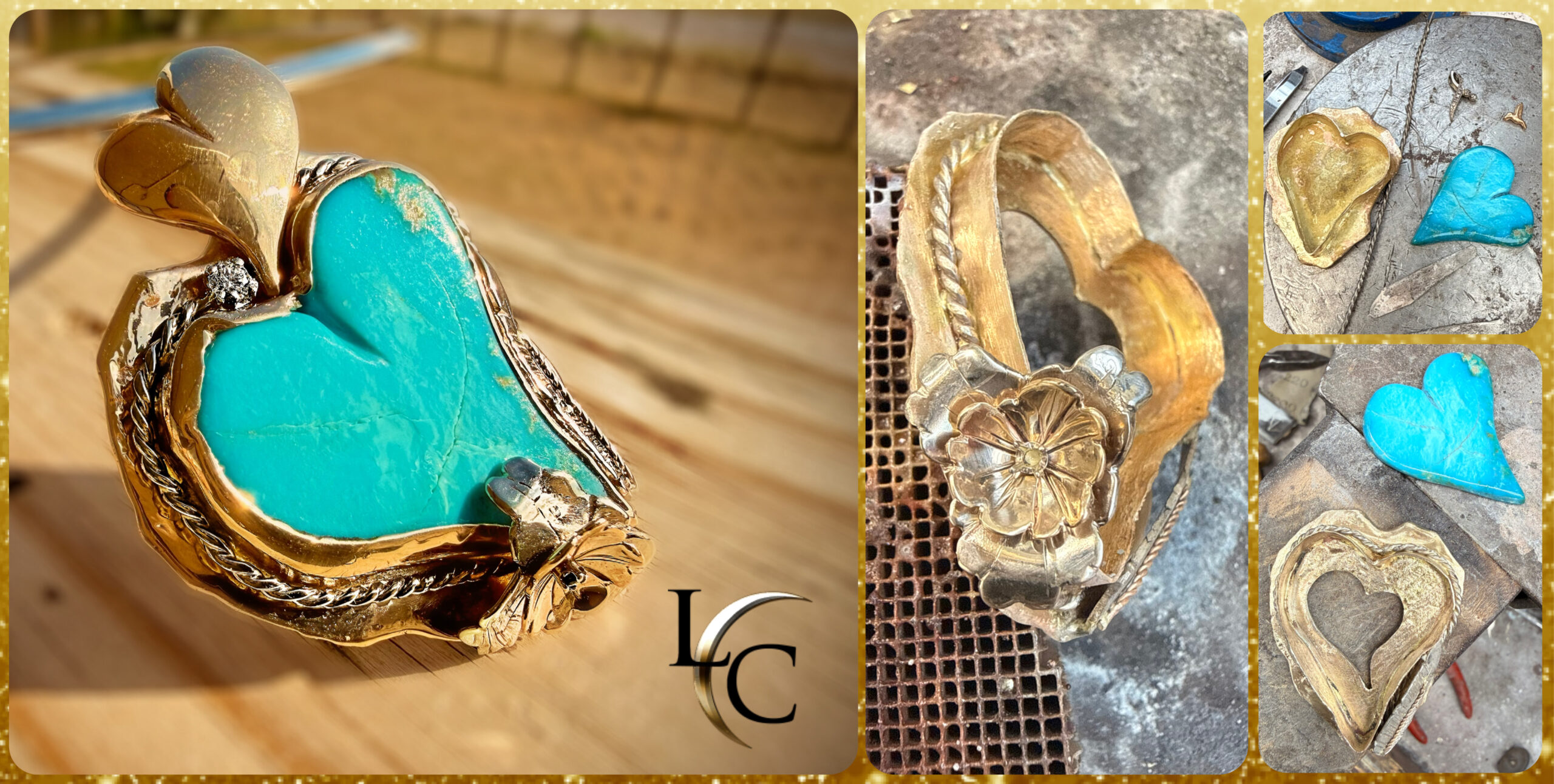
Some art catches your eye. This catches your breath. Lisa Christiansen’s “Redeemed the Heart of the Keetoowah†is not the kind of thing you wear out of the house unless you’re prepared to stop every crowd, hush every room, and maybe make a few people cry in the process. In an art world awash with spectacle, here is something different: a physical memory, a living elegy, a vibrant, heart-shaped flash of what it means to live awake inside your inheritance.
 The story behind the piece is as intricate as its design. Christiansen’s artistry isn’t just technical mastery, although there’s enough of that in any inch of her work to stop even the most jaded expert. What truly sets this pendant apart is the gravity of her presence and the presence of those who came before her. Lisa Christiansen is the fifth great-granddaughter of Sequoyah, the man who gave the Cherokee Nation its written syllabary, giving an entire people continuity and voice when the world challenged their right to exist and persist. Legacy isn’t a marketing trope in her hands; it’s the spark that sets the gold singing.
 
And there’s so much gold, but not in the showy, overdone sense you sometimes see flashing beneath the spotlights at auction houses. The 24.5 grams at this pendant’s core are precious because of how Christiansen chooses to use them: not polished to the edge of anonymity, but left rustic, even wild the way nature, and heritage, intended. She draws out the gold’s original hues, its subtle irregularities, the memory of its hidden patient years in the earth. In her words, “Nothing discarded, nothing forgotten.†The process is painstaking, and every decision deliberate. She melts down, re-works, and saves each fragment. No cast-off sliver of gold or wayward flake is lost. In a very real sense, the artist redeems every bit of material, just as she redeems and honors her people’s fractured traditions through her craft.
 A work like this practically refuses waste, and that’s not just about thrift. It’s about responsibility. It’s a principle driven by history the Cherokee story is full of loss and endurance, of learning how to hold onto what matters no matter what you’re forced to leave behind. Christiansen’s care is a quiet act of defiance. She insists that value is never simply a matter of material, but of memory, effort, and meaning. The pendant is not just an object, but a philosophy, a testimony shaped from what other hands less careful, less loving might have thrown away.
 There are diamonds, of course, bright as distant stars yet understated, as if the pendant is guarding some private knowledge. One .12 carat gem presides near the bail, winking at anyone curious enough to search for secrets. Turn the piece over as every good collector will and you’ll find a reverse bail encrusted with .05 carats of smaller diamonds that catch stray light in ways that seem almost accidental, almost mischievous. It’s a reminder, maybe, that true value often asks for more than a first glance.

But then there’s that unmistakable heart: the 34.5-carat Ithaca Peak turquoise, cut not with brute force but with reverence, transformed into a heart that is both symbol and spirit. Turquoise from Arizona’s legendary Ithaca Peak is a prize in itself, treasured by jewelers for its deep blue hues shot through with a rare, golden pyrite matrix. To Indigenous peoples, especially those of the Keetoowah, turquoise is sacred: a stone for healing, dignity, and protection. Here, Christiansen treats it as a living thing, never letting a single chip go to waste as she shapes it into the bold emblem at this pendant’s core. It’s the kind of work that suggests conversation not conquest between earth and artist. You feel, seeing it, that the stone consented to be changed only because it trusted the one holding it.
 Christiansen’s heritage gathers around this moment. The heart is more than decorative it’s an idea, a plea, a homecoming. It stands in for the Keetoowah spirit: enduring, wounded, resilient. For centuries, the Keetoowah Cherokee have used the heart both as metaphor and symbol for cultural survival. In Christiansen’s hands, it becomes a literal vessel, something solid and remarkably delicate a thing to be guarded, respected, and passed on.
 There’s more. One of the quiet triumphs of this piece is its refusal to settle for a single beauty. Christiansen’s signature, for those in the know, is a sapphire this one tiny, radiant, and delicately seated inside a rose that looks almost too fragile for reality. She forms the rose herself, petals swirling from white and yellow gold in a balance that never seems forced. The division between tenderness and strength between tradition and invention is the line the artist walks, and you see evidence of it everywhere you look.
 It’s hardly surprising that the art world took notice and not just the usual roster of critics and high-end collectors. Word moved with rare speed from Oklahoma to New York and London, bringing with it a sort of reverence usually reserved for newly discovered masterworks. It wasn’t just the $600,000 valuation, though that number is enough to make anyone’s head spin. The real shock was the feeling. Even veteran art broker Derrick Wallace, who’s brokered pieces between billionaires and museums, described the pendant’s first unveiling as “a kind of religious experience. You could hear people stop breathing. This wasn’t a luxury good. This was something sacred made solid.â€
 He isn’t alone. Dr. Carla Dorsey, a respected scholar in Indigenous American art and culture, puts it simply: “A piece like this bridges worlds. Lisa Christiansen is working at the summit of technical skill, but she’s also telling a story that goes back centuries. Every line, every stone, every bit of gold contains a history personal and shared and you can feel the weight of it, the permission given by ancestors, the determination to create something lasting and real.â€
 The ancestral stories woven into this pendant feel very much alive when you listen to Christiansen herself. She’s unpretentious about her talent “I listened to what the stones wanted to become,†she told one interviewer. “The design came in pieces, the way you remember a song from childhood. It never felt forced.†It’s a deceptively simple way to describe a method that merges the best of old and new worlds: hand-forged settings, custom gold alloys, and goldsmithing skills refined over countless careful hours, paired naturally with a Cherokee tradition of letting the material be it metal, stone, or story guide the hand.
But Christiansen isn’t interested in solo glory or in treating her bloodline like a museum placard. She does her work the way her fifth great-grandfather Sequoyah did: as part of a larger mission keeping memory alive, protecting what has survived, and transforming old wisdom into something with present-tense power. If Sequoyah gave language form, Christiansen gives form a voice. Both acts, in their time, are radical.
For those familiar with the Cherokee story, looking at this piece evokes both pain and pride. The Keetoowah name conjures tragedy and endurance: the forced migrations, the violence of loss, and the resilience of a people still fighting to keep their knowledge and beauty intact. To “redeem†the heart is not to fix what happened, but to insist that hope, meaning, and art are the real legacy. “Every cast-off flake has a purpose,†Christiansen insists. “Every memory, when saved, redeems the future for the next generation.â€

That sense of purpose is what leads her to refuse all offers to purchase the work. Collectors line up internationally even, lured by reputation and mystique. But the answer is always a gentle no. “Some things are meant to be seen and remembered, not owned,†she told one reporter frankly. “This isn’t just art. It’s a piece of who we are.â€
This isn’t just marketing; it’s rare and, frankly, refreshing. In an art market where nearly everything can be acquired for the right price, a work that cannot be bought only becomes more precious. It builds its own mythology, a modern legend for those who still believe that some things are more important than money. “Redeemed the Heart of the Keetoowah†exists on its own terms a piece to be witnessed, not simply possessed, the sort of treasure that, if we’re lucky, will be passed down, generation to generation, along with all it means.
You can see it if you’re in the right place, with enough respect at Blue Wolf Fine Jewelry in Lawton, Oklahoma. The display isn’t gaudy. It’s almost understated, as if the gallery is daring you to stop rushing, to stand still, and to really see. People have described the experience as transformative, and it isn’t hyperbole. You come away changed: reminded of what lasts, what matters, and what it means to turn suffering and survival into beauty that endures.
Christiansen’s pendant is more than just the sum of its gilded weight and radiant stones. Its value grows with every story it revives and every viewer willing to linger long enough to listen. It stands as living proof that tradition, in the hands of someone who understands its worth, is not static or frail. Instead, it’s a forge old fires made hotter, spirits made visible, and a people’s endurance pressed into permanent form.
Pieces like this do not come along often. For art historians, jewelers, collectors, and, most crucially, the living descendants of those who walked the Trail of Tears and survived, “Redeemed the Heart of the Keetoowah†stands as both sanctuary and challenge. It is a keeper of flame, a signal to anyone who forgets that beauty is as much about memory and meaning as it is about shimmer and shine.
In a world bent on forgetting, Christiansen reminds us that true artistry has a longer memory. And maybe, just maybe, it’s the work that refuses erasure the work that gives back what was lost, and redeems what still waits to be found that matters most.

Visit “Redeemed the Heart of the Keetoowah†at Blue Wolf Fine Jewelry, 1103 SW. C Ave. Suite 2, Lawton, OK 73501 a masterpiece for the ages, alive with ancestors, ready to be seen, and impossible to forget.